1. The Hidden Dangers of Cheap Floor Waxes
Many local contractors offer tempting low-price 'marble polishing' at ₹15 to ₹20 per sq. ft. In reality, they skip the laborious diamond grinding steps, clean the floor superficially, and smear liquid acrylic or carnauba wax with a rotary buffer.
- While the floor looks shiny for the first 14 days, the long-term consequences are devastating:
- Yellowing & Discoloration: Exposure to ambient UV light oxidizes the wax film, turning white Statuario or Carrara marble dingy yellow.
- Moisture Trapping (Efflorescence): Natural stone absorbs groundwater and subfloor humidity. Wax seals the pores shut, preventing moisture evaporation. The trapped salts crystallize beneath the surface, popping off microscopic stone chips.
- Scuff Lines & High-Traffic Graying: Footwear drags grime directly into the soft wax layer, making doorways and hallways look blackened and dirty.
Contractor Warning
If a contractor promises to 'polish your 1,000 sq ft house in 4 hours for ₹15/sq ft', they are applying temporary wax that will take expensive grinding to strip later.
2. The Technical Chemistry of Crystallization
Crystallization is not a topical coating. It is an internationally recognized thermo-chemical restoration technique:
- 1A specialized solution containing fluosilicic acid and magnesium fluorosilicates is misted onto clean, honed marble.
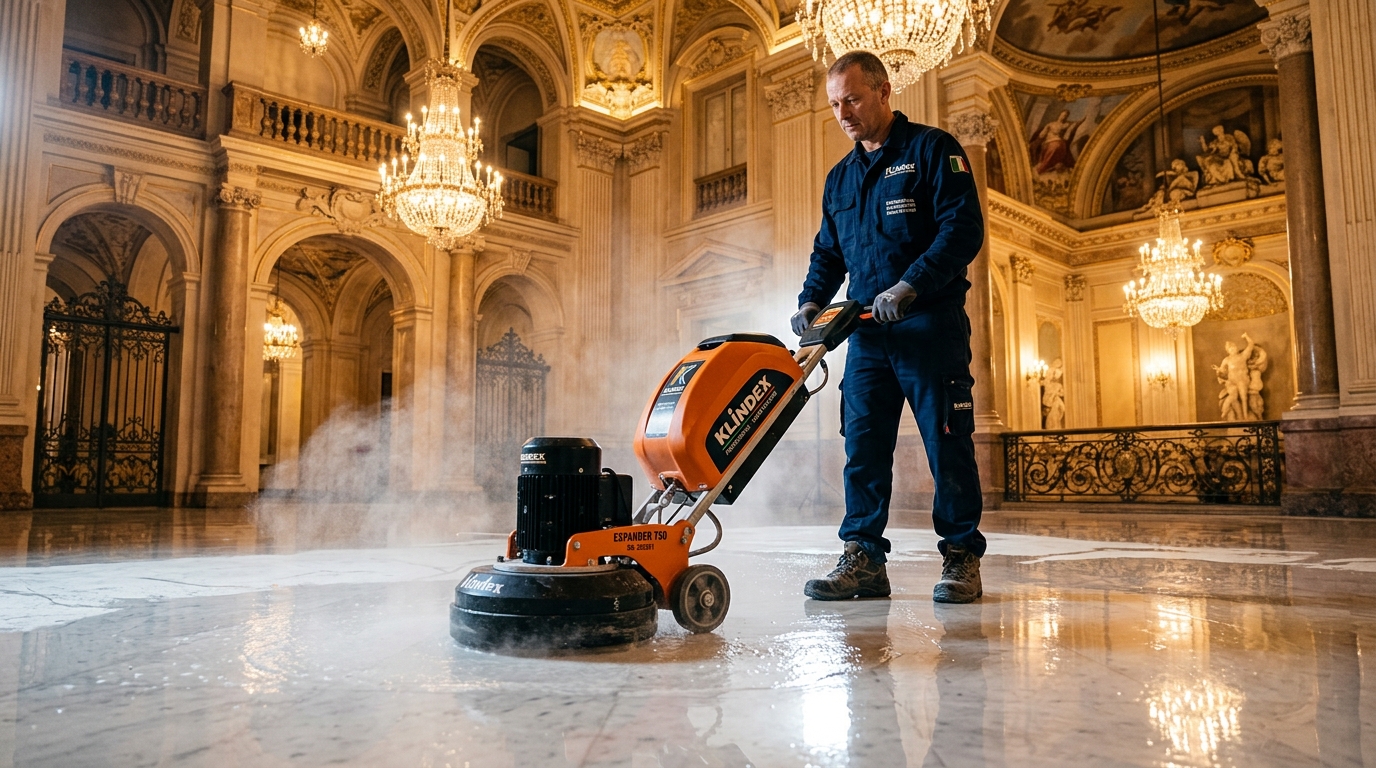
- 2An industrial 175 RPM rotary machine fitted with #0 or #1 grades of woven steel wool or diamond-impregnated fiber pads buffs the liquid.
- 3The friction produces heat ($40^\circ\text{C}$ to $50^\circ\text{C}$), prompting an immediate ion exchange reaction: $$CaCO_3 + \text{Fluosilicate} \longrightarrow CaSiF_6 + CO_2 + H_2O$$
- 4The resulting calcium fluorosilicate surface is impervious to acid splashes, resistant to abrasion, and preserves the natural translucency of the stone.