1. Why Italian Marble Demands Distinct Restoration Protocol
Italian marble is prized worldwide for its exquisite natural veins, translucent mineral depth, and luxurious ambiance. However, geologically, it possesses a high calcium carbonate (calcite) percentage and moderate porosity. Unlike dense granites or compact Indian marbles (like Makrana), Italian stone is extraordinarily susceptible to acidic etching (lemon juice, vinegar, soft drinks, and harsh floor cleaners).
When conventional cleaners or cheap wax polishers treat Italian marble, they create an artificial synthetic plastic film. Over 6–12 months, this film turns yellowish under Bangalore sunlight, traps moisture underneath, and causes micro-spalling of the precious vein structure. Genuine restoration must work directly on the stone crystal lattice.
Standard commercial house-cleaning acids cause immediate irreversible chemical burns on Italian marble, requiring aggressive mechanical grinding down to 0.5mm to fix.
2. The 7-Stage Diamond Grinding & Honing Progression
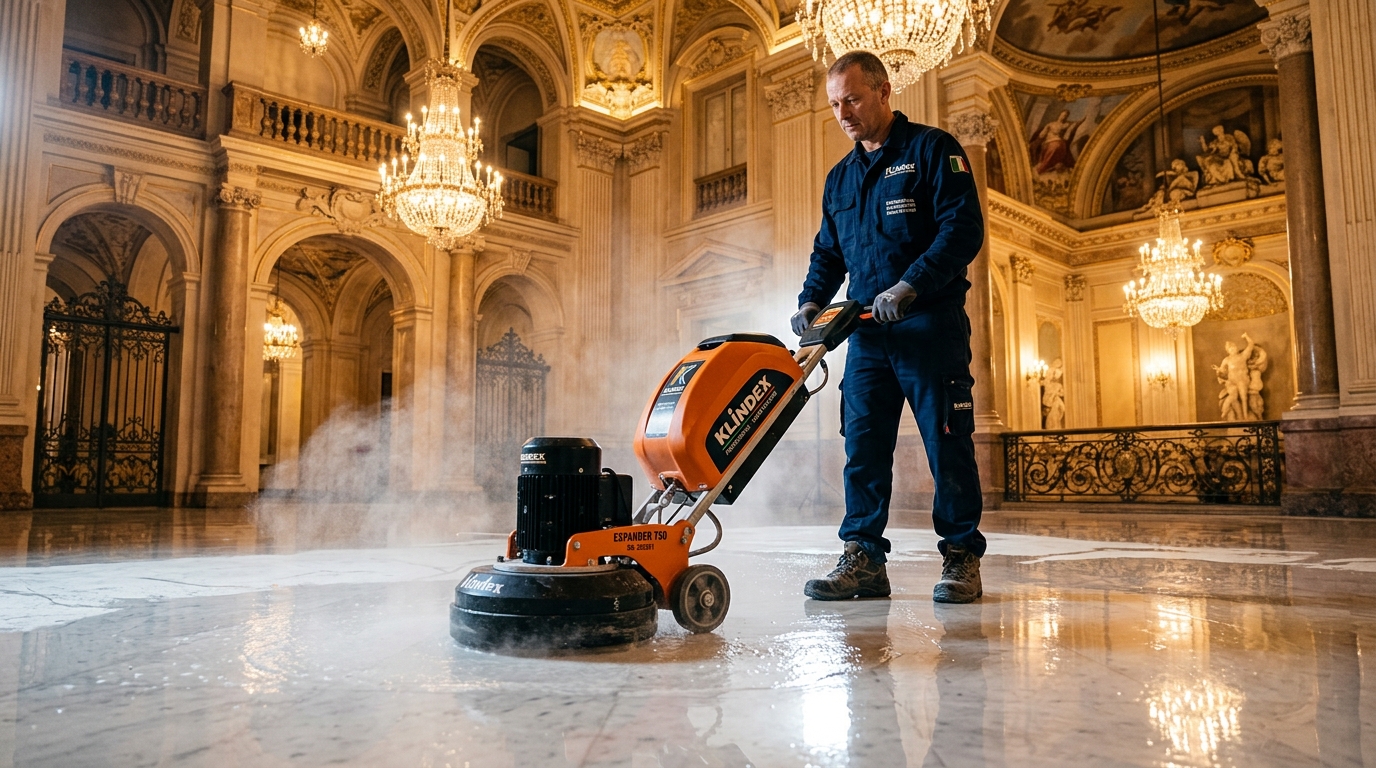
Professional Italian marble polishing requires wet diamond abrasive discs attached to industrial planetary floor machines (150–200 kg down-pressure). The process follows calibrated grit sequences:
- 1Lippage Leveling (Grit #50–#100): If tiles have height differences at the joints, coarse metal-bond diamond discs shave the stone flat, turning separate slabs into one continuous monolithic mirror.
- 2Deep Scratch Removal (Grit #200): Erases footprints, pet scratches, and dragging marks from furniture.
- 3Primary Honing (Grit #400–#800): Refines the scratch pattern into a silky satin finish. Vein colors become vivid and deep.
- 4Micro-Fine Honing (Grit #1500–#3000): Closes microscopic surface pores, preparing the stone crystals for reflection.
- 5Epoxy Grouting & Pinhole Filling: Natural Italian marble has tiny natural cavities. We fill them with color-matched UV-stable Italian polyester/epoxy mastic resin.
 After (Restored)
 Before (Dull)
3. The Science of Silicate Crystallization (Not Wax!)
Wax polish sits on top of marble like plastic wrap. In contrast, crystallization is a thermo-chemical reaction between calcium carbonate in marble and a specialized fluorosilicate compound applied with heavy steel-wool pads.
The friction generates heat (approx. 45°C–50°C), converting the top 3–5 microns of calcium carbonate into calcium fluorosilicate. This hardens the surface by 2 points on the Mohs scale, transforming dull stone into a scratch-resistant, mirror-reflective, glass-hard surface that allows the stone to breathe naturally.
Test your floor with a gloss meter. Untreated dull marble reads 15–25 GU (Gloss Units). Proper diamond polishing and crystallization achieves 85–95 GU with zero optical distortion.
4. Maintenance Rules for Bangalore Homeowners
Once your marble has been polished to perfection by Shree Dwarka Marble Polishing Service, follow these daily guidelines:
- Use pH-Neutral Stone Cleaner Only: Mix 1 cap of neutral stone soap with lukewarm water. Never use detergents containing bleach, ammonia, or citrus extracts.
- Microfiber Mops: Use dry microfiber flat mops to eliminate dust particles. Bangalore dust contains hard silica quartz grains that act like sandpaper under foot traffic.
- Entryway Floor Mats: Place breathable runner rugs at main doors and balconies to trap grit.
- Wipe Spills Immediately: Red wine, coffee, tea, and sambar contain acidic tannins. Wipe them within 5 minutes with a damp cloth.